E³I CIVIL INTELLIGENCEHEAVY CIVIL ESTIMATING + PROJECT CONTROLS
CONTROLLED PROJECT INTELLIGENCE · HUMAN APPROVAL

LOCK THE BID.
TRACE THE WORK.
IMPROVE THE NEXT.

E³I connects the original bid, field evidence and accounting-controlled actuals without rewriting history. Unmatched work receives a temporary task identity, passes classification and verification, and becomes reusable knowledge only after responsible people approve it.
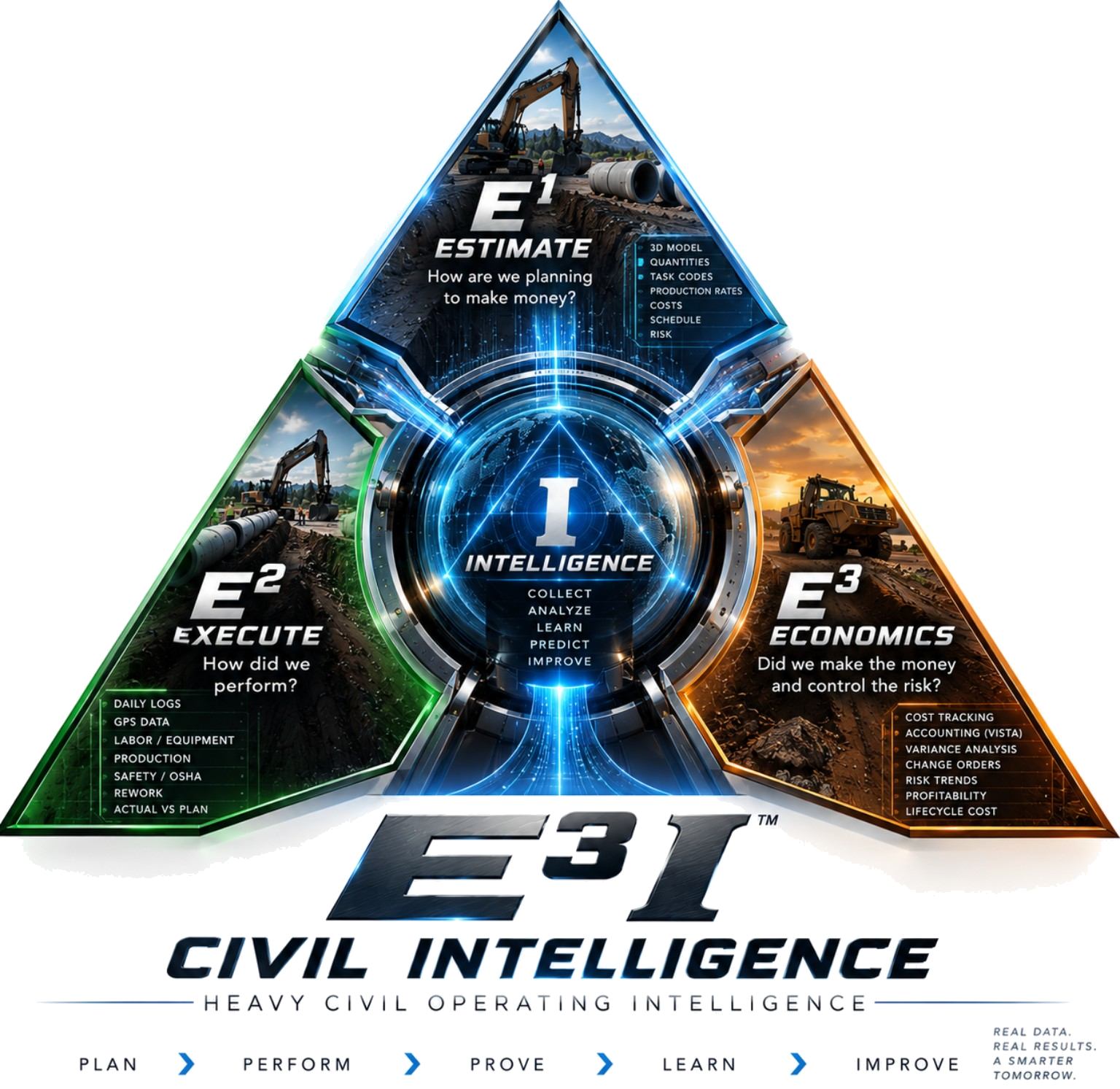
One task. One identity. Full lineage. AI analyzes and recommends. Operations and accounting verify. Humans approve every change to future estimating knowledge.
E3I Civil Intelligence Triangle logo
LIVE WEBSITE / UPDATED SEPTEMBER 2026
E¹ → E² → E³ → I → HUMAN REVIEW → E¹

One project.
Intelligence carried forward.

Illustrative project · Sample task codes and values.
A demonstration of the workflow, not live project data or an operating software platform.

Heavy-civil earthwork project, used as the setting for an illustrative utility task
PROJECT A / UTILITY CORRIDORSCHEMATIC OVERLAY
PLAN → MODEL → QUANTITY → TASK280 LF / DEMO-U01
ONE TASK / FULL LINEAGE01 / 06

Build the estimate. Lock the baseline.

Issued plan and accepted model quantities become a traceable task, crew, equipment, production assumption and cost. The approved original bid stays locked.

Task identity
DEMO-U01 · 12″ utility
Baseline quantity
280 LF
Planned production
70 LF/day · 4 days
Illustrative task cost
$12,000 · BID v1 locked
SOURCE → QUANTITY → UNIT → TASK → BID v1
Original BID v1 · 280 LF · 70 LF/day · $12,000 · LOCKEDNew evidence links back. It never overwrites the bid.
Plays while in view · pauses for human review

Source → quantity + measurement → task + condition → date + reviewer → approval + version. Every record keeps its own identity.

THE CONTROL PROBLEM

New work appears.
The original bid must remain true.

Field conditions do not always match the estimate. Work may be genuinely new, changed, rework, an estimator omission, a field performance issue, an indirect cost or an accounting miscoding. Placing every unmatched dollar into a generic “Other” category hides the cause and weakens the next estimate.

E³I preserves the approved bid as a locked historical baseline, captures unmatched activity under a temporary task ID and requires evidence-based classification before any project actual or future estimating rule is changed.
SERVICES BUILT AROUND CONTROLLED EVIDENCE

Four ways to start.
One governed architecture.

Each engagement preserves the source, project, task, quantity, unit, condition, date, user, approval and version behind every decision.

01 / BASELINE

Build or review the bid

Connect scope, quantity, method, resources, production, price basis and risk into an approved baseline that remains locked and reconstructable.

REQUEST A BASELINE REVIEW →
02 / FIELD CONTROL

Capture unmatched work

Issue a temporary task ID so quantities, labor, equipment, materials, tickets, conditions and dates remain traceable without changing the bid.

DISCUSS FIELD CONTROLS →
03 / CLASSIFICATION

Verify the reason for variance

Compare evidence across operations and accounting, classify the cause and keep unresolved items visible until responsible reviewers decide.

REQUEST A CLASSIFICATION REVIEW →
04 / CONTROLLED LEARNING

Improve future estimates

Create a project-specific learning record and a separate future-template recommendation for human approval and version-controlled release.

DISCUSS CONTROLLED LEARNING →
THE VISITOR PATH

Know what to bring.
Know what happens next.

The first contact is a project conversation, not a document upload. Use non-confidential information to identify the decision, the available evidence and the right starting service.

01 / CHOOSE THE DECISION

Name the result you need

  • Estimate or quantity review
  • Field tracking or task-code setup
  • Production drift or corrective planning
  • Financial reconciliation or closeout
02 / PREPARE THE CONTEXT

Send a short, non-confidential outline

  • Company and project type
  • Current project stage
  • Scope or task causing concern
  • Decision needed and useful date
03 / DEFINE THE REVIEW

Agree before records move

If the fit is right, E³I defines the scope, people, evidence needed, deliverables, secure handling method, timing and fee in writing. Unknown facts remain open until supported.

THE E³I MASTER ARCHITECTURE

Preserve history.
Control what changes next.

The original BID is the approved historical baseline. It is never silently rewritten by field activity, accounting cleanup, AI output or later learning.

Governing rule: AI analyzes and recommends. Operations verifies the work and cause. Accounting controls verified actual dollars. Humans approve classifications, learning and every future library change.
01 / LOCKOriginal BID baselinePreserve quantities, units, production, resources, assumptions, exclusions, price and approval version.
02 / CAPTURETemporary Task IDAttach unmatched activity, condition, quantity, labor, equipment, material, tickets, photos, dates and users.
03 / CLASSIFYIntelligence gateCompare the temporary record to the bid, field evidence, commercial record and accounting.
04 / VERIFYProject ActualHuman, operational and accounting review produces traceable actual quantities and dollars without a generic Other category.
05 / LEARNControlled future updateSeparate the project learning record from a future-template recommendation; approve and version every Master Task Library change.
Existing taskGenuinely new taskChanged condition / change orderReworkEstimator omissionField performance issueIndirect costAccounting miscoding
RESULTS OF THE CONTROLLED FLOW

Every result has a place.
Every change has an owner.

PROJECT RECORD

Verified Project Actual

Every quantity and dollar remains linked to its source, measurement method, condition, date, user, approval and version.

COMPANY MEMORY

Conditional learning

One occurrence becomes a historical observation under its recorded conditions. It does not automatically become a universal production standard.

FUTURE ESTIMATING

Approved library revision

A separate recommendation explains what should change, why, where it applies and who approved the new version.

Illustrative example: a field crew encounters unmatched utility work. E³I would capture it under a temporary task, classify and verify the cause, reconcile its actual cost and preserve the lesson. This example explains the method; it is not presented as verified real-project performance.
THE METHOD, PLAINLY

Separate the records.
Connect the lineage.

The bid, temporary task, verified actual, learning record and future template are distinct controlled records. Their links create the audit trail; none replaces another.

Provenance stays attached.Source documents, quantities, measurement methods, conditions, dates, users, approvals and versions travel with the decision.
01

Original BID Baseline · lockedReconstructable history of what was estimated and approved.

02

Temporary Task ID · openA safe holding record for unmatched work and evidence while the bid remains unchanged.

03

Classification Decision · approvedA recorded cause and destination supported by operations, commercial and accounting evidence.

04

Verified Project Actual · controlledAccounting-authoritative actual dollars reconciled to field quantity and project scope.

05

Project Learning Record · conditionalA historical observation with its evidence, conditions and limits.

06

Master Task Library · versionedChanged only through a separate recommendation and explicit human approval.

BEFORE THE TASK CODE

Start with the source.
Keep the trail.

A task begins with a controlled call-out inventory—not a guessed code. Each physical item of work is counted once while every plan, detail, specification and quantity source remains linked to it.

Unresolved information stays visible. Incomplete information is marked ambiguous. Applicable sources that disagree are marked conflicting. Neither is silently converted into a bid assumption.
01 / INVENTORYReview the complete issued setConfirm sheets, revisions and addenda, then work in order so scope is not skipped.
02 / TRACEPreserve the exact call-outKeep the original wording, location, detail, specification condition, quantity and unit attached.
03 / COMPARECheck plan and model evidenceA model quantity is used only after its source, revision, units and validation are accepted for that purpose.
04 / RESOLVEHold questions for reviewMaterial differences, missing references and incompatible requirements go to human review or an RFI.
E³I Civil Intelligence · Complete operating flow

FROM SOURCE EVIDENCE
TO COMPANY MEMORY.

Lock the approved bid, capture unmatched field activity without altering it, classify and verify the cause, reconcile the actual result and carry only approved, conditional learning into a version-controlled future template.

Available now: hands-on consulting workflow Evidence led: baselines and revisions stay traceable In development: secure client platform automation
Civil construction workflow from plans and model through field production, reconciliation and reviewed learning
One task. One identity. Full lineage.The bid stays locked. Every unmatched activity receives a temporary identity until people verify its correct classification and actual result.
Stage 1 · Original BID Baseline LOCKED

Preserve exactly what was approved.

Freeze the accepted quantities, units, production, crews, equipment, costs, price, assumptions, exclusions and approval version. Later facts link back to this record; they do not rewrite it.

Record carried forwardIssued sources, quantity, unit, method, resources, production, cost, price, assumptions, exclusions, user, date and version.
Human gateEstimator and responsible team approve and freeze the baseline.
AI assistanceCheck formulas, units, duplication and missing support; never overwrite approval.
BoundaryThe historical bid remains reconstructable after every later event.
Source documents and survey evidence linked to a terrain model under human review
Baseline approval

No generic “Other.” Classify the cause.

The temporary task holds every cost and quantity while reviewers decide whether the work belongs to an existing task, a genuinely new task, changed condition or change order, rework, estimator omission, field performance issue, indirect cost or accounting miscoding.

Classification and verification lane
LockOriginal bid remains unchanged
CaptureTemporary task receives all evidence and costs
ClassifyAI compares; people determine the cause
VerifyOperations confirms work and conditions
ReconcileAccounting controls actual dollars
LearnProject-specific observation retains conditions
ApproveFuture library update receives a new version

The public example is illustrative. It explains the controlled path and does not claim verified performance from a real client project.

Authority stays explicit.

Evidence moves through the system while each decision remains with the person or function responsible for it.

Evidence lane
Sources→Quantity + method→Conditions + dates→Users + approvals→Versions
Human control
Estimator locks bid→Field verifies work→Operations verifies cause→Accounting verifies dollars→Authorized owner approves library
AI assistance
Organize→Trace→Compare→Flag→Recommend→Never self-approve
Operations verifies the physical record

Method, location, access, material, depth, equipment, crew, sequence, hauling, changed conditions and causes are confirmed before performance is interpreted.

Accounting controls verified actual dollars

Payroll, equipment, materials, invoices, commitments, billing and revenue remain governed by accounting records and reviewed allocation.

What is proven, what is practiced, what is still being built.

Available nowHuman-led consultingBaseline review, field controls, classification, reconciliation, closeout and controlled learning support.
Supported evidenceTraceable model and workbook examplesA preserved native model has been reconciled to its historical bid, and one reversible workbook scenario proves a narrow calculation path—not universal performance.
In developmentSecure platform automationBroader task-library validation, isolated client workspaces, controlled approvals and automated integrations remain development work.
Concept illustration · Generic example · No verified client-performance claimAI recommends; humans approve. Accounting controls verified actual dollars.
COLLECTIVE COMPANY KNOWLEDGE

Experience connected.
Knowledge carried forward.

The supporting experience record dates to 2007 and spans excavation, estimating, project leadership and company operations. The framework is designed to keep that knowledge available to the company instead of tying it to one person.

Heavy-civil workSubdivisions, public streets, rights-of-way, sewer, water and storm mainlines, septic and hardscape work.
Commercial leadershipCommercial and prevailing-wage projects, land-development planning, crews, schedules, changes and progress billing.
Model-to-field experienceAutoCAD, 3D civil models, GPS machine control, plan and grade reading, excavators, dozers and road graders.
WHAT THE FIRST REVIEW PRODUCES

A defined next step.
A visible evidence boundary.

The project conversation identifies the decision and available source material. If E³I can support the need, the written engagement defines what will be reviewed, what will be delivered and how confidential information will be handled.

AVAILABLE NOW

Hands-on consulting and review

Estimating, job controls, project review, corrective planning, reconciliation and closeout support shaped around the agreed project need.

DEFINED IN WRITING

Scope, evidence and deliverables

The people, records, review outputs, secure handling method, timing and fee are agreed before confidential project documents are shared.

IN DEVELOPMENT

Secure client platform

Dedicated online intake, client workspaces, automated integrations and broader platform functions remain in controlled development and testing.

HOW INFORMATION IS HANDLED

Agree first.
Share securely second.

No confidential project documents should be submitted before the work, responsibilities, confidentiality terms and secure handling method are agreed in writing.

Purpose-limited accessAccess is limited to the people doing the agreed work.
Separate client recordsProject records are handled within the agreed client scope and method.
No unapproved cross-client useConfidential records are not used for another company without written authorization.
Human responsibilityProject decisions remain with the responsible people and written agreement.
WORKING CONTACT ROUTE

Build a clear request.
Send it by email.

The brief builder works on this device and does not upload project information. Use non-confidential context only. Do not attach plans, estimates, models, financial records or other confidential documents until a written scope and secure sharing method are agreed.

Project review brief

Choose the need, describe the decision and prepare a structured email. Required fields are marked.

What happens next

E³I reviews the general request and responds through the available contact information. A consulting relationship begins only after scope, responsibilities, deliverables, secure handling, timing and fee are agreed in writing.

info@e3icivil.com

Current boundary

Email is the established public contact route. Dedicated online intake, client workspaces, document upload and automated integrations are not yet public operating services.

SECURE PROJECT INTAKE / IN DEVELOPMENT